


Where Website Leads Commonly Leak
A form can submit successfully while the enquiry still disappears from the sales process. The notification may reach an unattended inbox, two people may assume the other will respond, or a WhatsApp conversation may remain only on one employee's phone.
Leakage also happens later. A first reply is sent but no reminder is created, the customer asks to speak next week but the date is not recorded, or a closed conversation has no reason. A lead system must preserve the enquiry, show who owns it and keep the next step visible until an outcome is known.
- Capture failure: the enquiry is never stored.
- Notification failure: the right person is not alerted.
- Ownership failure: nobody is accountable for the next action.
- Follow-up failure: an unfinished conversation has no reminder.
- Learning failure: source and outcome are missing.
In This Article
What a 25-Advertiser Review Can and Cannot Show
In the DSE Meta Ad Prospect Review, August 2026, 17 reviewed prospects were labelled High and 8 Medium. The largest categories in this descriptive sample were Healthcare & Wellness (6) and E-commerce & D2C (5). These are DSE evaluation labels inside an internal descriptive sample of 25 active advertisers, not an India-wide prevalence estimate.
The chart is useful for exploring the composition of this small review. It cannot establish market size, sector performance or how frequently any weakness occurs across Indian businesses. Use it as a prompt to inspect a specific enquiry journey, never as proof about an industry.
Industry and Opportunity Distribution in a 25-Advertiser Review
Selected: Healthcare & Wellness, 6 of 25 advertisers (24%).
Build the Complete Enquiry Flow
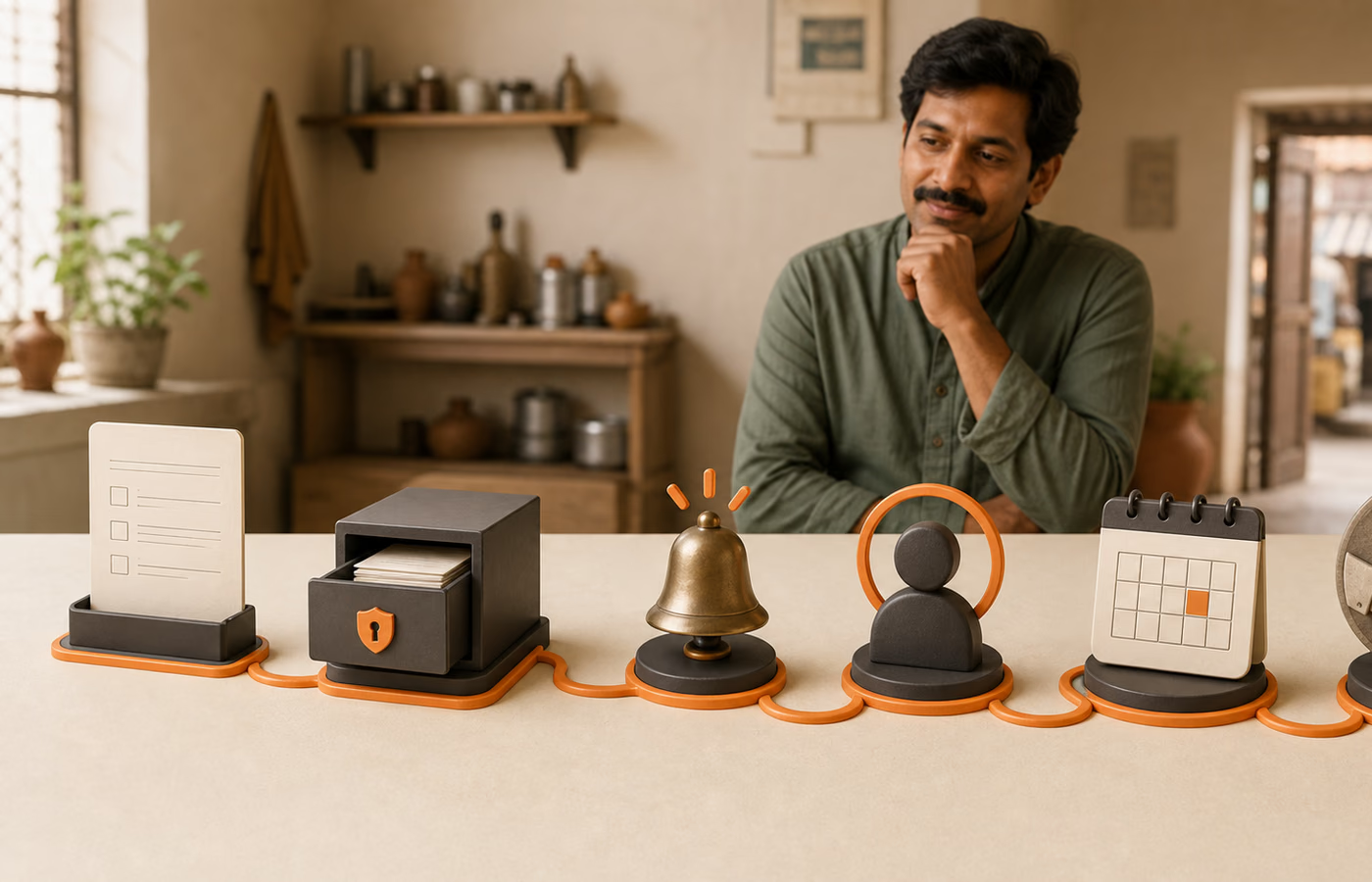
A dependable flow begins with protected capture, then connects storage, notification, ownership, follow-up and outcome. The website, advertising form, telephone note and messaging conversation may begin differently, but they should create the same minimum lead record.
Treat every form submission as untrusted input. Apply server-side validation even when the browser already checks fields. Add proportionate spam and abuse protection, such as rate limits, a honeypot or an accessible challenge when risk justifies it.
Reject invalid or abusive submissions before creating a lead record. Return a safe response, then log a safe reason and request ID without copying the full message or sensitive fields into operational logs.
Test the flow end to end with a clearly marked test enquiry. Confirm where it is stored, who is notified, how the owner is assigned, whether a reminder can be set and how the final outcome is recorded. A success message on the website proves only the first moment.
- Validate and protect the submission on the server.
- Capture the accepted enquiry and its source.
- Create or update one shared lead record.
- Send a dependable notification.
- Assign one responsible owner.
- Record the next action and its due time.
- Close with a specific business outcome.
Store Clean Records and Prevent Duplicates
Choose one shared system of record: a suitable CRM, a controlled business tool or a carefully managed sheet for a very small team. Every entry should use the same fields and status names. Free-text notes can add context, but they should not replace structured source, owner, stage and next-action fields.
Deduplicate with a normalised phone number and email address, then retain the earlier history when the same person returns. Do not silently overwrite a record or create a second customer journey every time a campaign form is submitted.
- Lead ID and received time
- Contact details supplied by the person
- Source, campaign and landing page where available
- Owner, stage, next action and due time
- Consent context, notes and final outcome
Connect Notification, Ownership and First Response
A notification should reach the working channel of the responsible team, but the shared record remains the authority. Use clear escalation rules when an enquiry is unassigned or the first-contact deadline is missed. Avoid sending full personal details into unnecessary group chats.
The March 2011 HBR article reports two separate U.S. research exercises. An audit of 2,241 U.S. companies measured response practices for web-generated test leads.
A separate analysis of 1.25 million sales leads received by 29 B2C and 13 B2B companies in the U.S. found that firms attempting contact within an hour were nearly seven times as likely to qualify the lead as firms trying even an hour later.
In that analysis, qualify meant a meaningful conversation with a key decision-maker. These older U.S. findings are not an India-specific guarantee. Their practical use is to justify measuring response time and setting a realistic service standard for your own team.
Sources and related reading
Use Reminders and Simple Lead Stages
A lead is not finished because the customer did not answer once. Record the agreed next action and an appropriate date. The reminder should reopen the record for the owner, not create a disconnected note elsewhere.
Keep stages few enough that the team can use them consistently: New, Assigned, Contacted, Qualified, Follow-Up, Won and Closed. Define the evidence needed to move between stages. Closed should include a reason such as no response after the agreed sequence, outside service area, unsuitable requirement, lost to another option or customer deferred.
Record Source and Outcome Together
Source attribution is incomplete if it stops at lead count. Preserve the original channel and campaign, then connect that record to qualification and final outcome. This lets the business see whether a high-volume campaign produces useful conversations or merely creates more work.
Use consistent outcome reasons and review them monthly. If many relevant people abandon one page, inspect the experience. If a source brings repeated out-of-area enquiries, correct targeting and page messaging. If qualified enquiries receive slow replies, repair the process before buying more traffic.
Sources and related reading
Adapt the Same System to Different Sectors
The fields change by sector, but the operating logic does not. A property enquiry may need project and visit preference. An education enquiry may need programme and intake. A clinic may need appointment context without collecting unnecessary health details in an open marketing form.
A local-service enquiry may need postcode, job type and urgency. A B2B request may need company, requirement and decision timeline. Decide what the first useful conversation needs, collect only that information and let the owner add verified detail later.
Handle Customer Data Responsibly
India's Digital Personal Data Protection Act, 2023 establishes the legal context for handling digital personal data. Build the operational basics with professional legal guidance where needed: clear notice, a valid purpose, appropriate consent where applicable, controlled access, reasonable security, retention limits and a way to handle relevant customer requests.
Do not collect extra personal information because a tool provides the field. Limit access by role, remove former team members promptly, document retention periods and avoid copying full records into personal devices. The 2025 India SME Forum digitalisation report is also a useful reminder that adopting a digital tool is not the end of implementation; a working process and team practice must sit around it.
Measure Whether the Lead System Works
Review the process each week and acquisition quality each month. Use medians as well as averages for time measures, because a few very late cases can hide what a typical customer experiences. Break results down by source, page, owner and enquiry type only where the sample is large enough to be useful.
Read the measures together. A fast first reply with poor follow-up completion is still leakage. A high qualified rate with no recorded outcomes prevents commercial learning.
- Capture success and notification delivery
- Time to assignment and first contact
- Qualified enquiry rate
- Follow-up completion by due date
- Won, lost, deferred and unsuitable outcomes
- Outcome by source and landing page
A Seven-Day Lead-System Checklist
Start with one priority enquiry source, prove the flow and then connect the others. Give the team a small shared definition sheet rather than relying on verbal explanations.
- Day 1: list every source, inbox, device and person currently receiving enquiries.
- Day 2: define the minimum shared record and the seven lead stages.
- Day 3: add server-side validation, spam and abuse protection, safe rejection logging, storage and notification.
- Day 4: add ownership, response expectations and escalation.
- Day 5: add reminders, duplicate handling and outcome reasons.
- Day 6: test normal, duplicate, failed and after-hours journeys.
- Day 7: review access, consent context, retention and the first dashboard.
Take the Lead Leakage Check
Answer the five questions for the process the team uses today. The result is immediate and no contact data is collected. If you choose the result action, your answer summary is carried to the Website Development form so the discussion can start with the process you described.

Sources and related reading
Question 1 of 5: Where do enquiries currently arrive: one system, email, WhatsApp, several inboxes or not sure?
Question 1 of 5
Lead Leakage Check
Check whether every enquiry is stored, owned and followed through to an outcome.